
When a new style hits the market, it is the culmination of countless decisions that fall along a timeline from ideation to finished product. One of those decisions is colour. At some point, a designer commits to a colour, approves a swatch, and locks in a shade. A critical decision that doesn’t just shape aesthetic, but triggers one of the most resource-intensive processes in manufacturing.
The environmental cost of colour
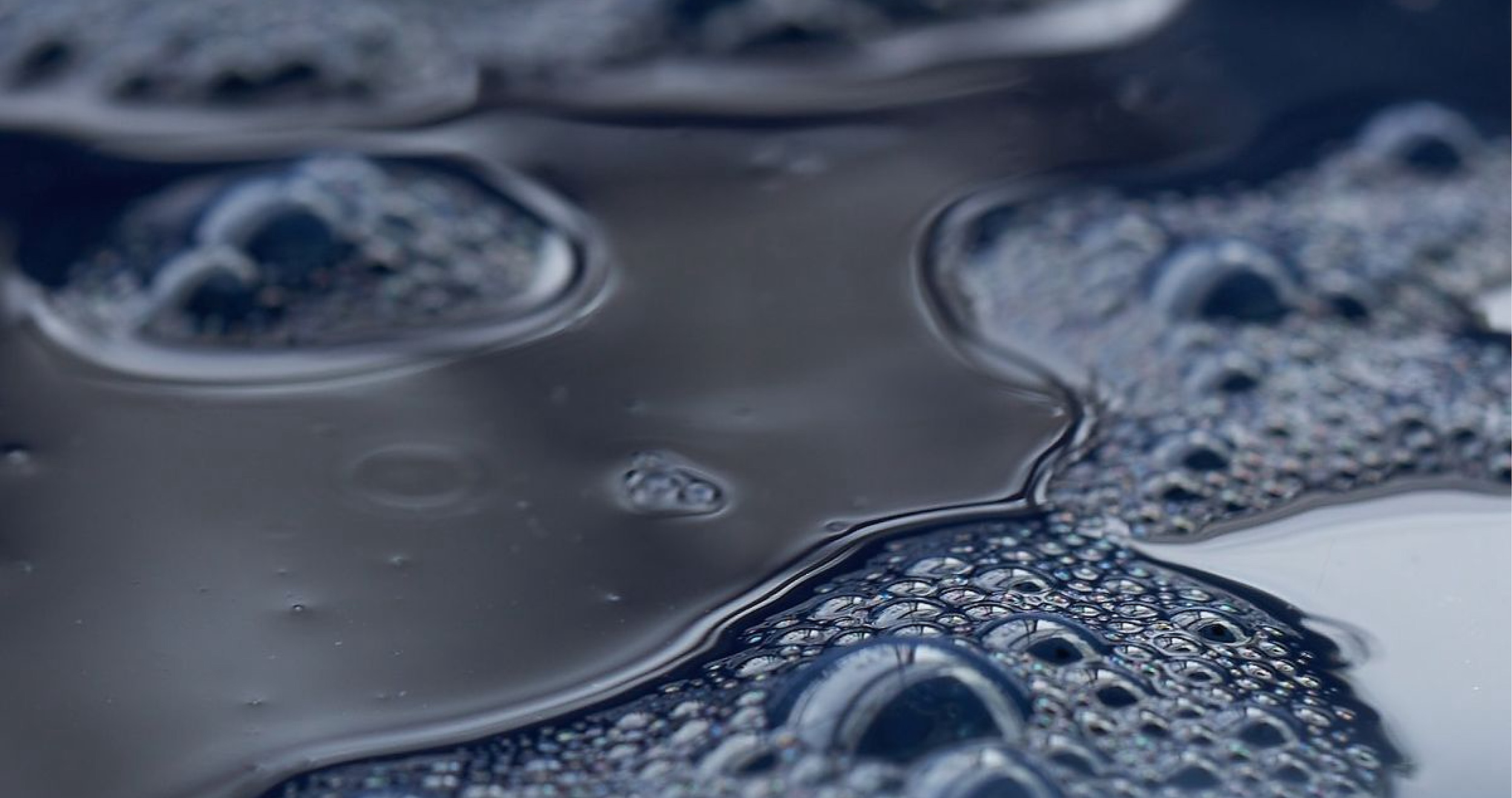
Wet processing, which covers pretreatment, dyeing, printing and finishing, is carbon intensive, thirsty and widely hazardous. According to Fashion for Good, 29% of the fashion industry's carbon emissions come from wet processing, yarn and fabric preparation stages alone. And fashion’s water impact follows suit. The textile industry uses an estimated 215 trillion litres annually, roughly equivalent to 86 million Olympic swimming pools.
The issue isn’t just volume, it’s toxicity. According to UNEP, 72 toxic chemicals have been identified in waterways traced back to dyeing alone, 30 of which cannot be removed through treatment.
Fashion's negative impact on water is particularly significant, held up against the reality that more than two thirds of the global population already live with water scarcity. For clothing and textiles, colour isn’t just aesthetics, it’s an intensive process for which our freshwater pays the price.
New technology with a timeline tradeoff
During the 1950s onwards, the industry refined a process that removed the need for a dye bath entirely. Often called solution dyeing or dope dyeing, this method introduces pigment directly into the polymer melt before synthetic fibres are extruded. Colour is built into the fibre at the moment of its formation, not applied to it afterwards.
The environmental case is meaningful. Solution dyeing can eliminate the dyebath entirely for synthetic fibres, reducing water use and chemical discharge. Colour fastness improves because the pigment is embedded rather than surface-applied and the process is more efficient. Fewer steps and less waste water.
But solution dyeing has supply chain problem that has prevented it from displacing conventional methods. Colour decisions must be locked in early. In an ever-faster moving production landscape, solution dyeing requires designers to commit to colour not only at fabric stage, but at fibre creation stage. This timeline shift means colour must be predicted (accurately) months before the fabric is finished and long before the product reaches market. Minimum order quantities are high because each coloured yarn variant must be produced in volume to be economically viable. Seasonal pivots are difficult. Sampling is expensive. It’s an environmental solution that compromises on flexibility.
Looking to nature for a solution
At Amphico, we recognised that nature had already solved this problem long before the textile industry set out to. Look closely at the shell of a tiger beetle and you find no single colour, but a field of microscopic dots, each reflecting its own narrow band of colour. The striking green of an emerald swallowtail, Papilio palinurus, is in fact an illusion: its wings hold tiny areas of blue and yellow set side by side, and the green we see is mixed not on the wing, but in the eye. This is optical mixing. Place small areas of separate colour close enough together, and the eye combines them into a single, unified hue.
Amphicolor works the same way. Instead of forcing colour into fabric with a dye bath, we weave together a small set of pigmented yarns. Once those yarns are finer than the eye can resolve, the fabric reads as one clean, continuous colour. No dye bath. No water effluent. And because the colour is built from many threads rather than a single flat shade, it carries a depth and a subtle play of light that applied pigment cannot reproduce.
What nature demonstrates is that colour and chemistry do not have to be the same problem. Solution dyeing understood this partially: it removed the toxic bath, reduced the water, shortened the process. But it kept colour locked to volume and to lead time, because pigment still had to be committed at fibre formation.
Colour engineered at the loom
Amphicolor™ is our predictive colour platform, built on the principle that colour is created through fabric construction and brought to life through intelligent weaving. It is designed to do what solution dyeing could not: remove the dye bath without removing creative flexibility or commercial agility.
The platform works by modelling how colour emerges at the weaving stage. Rather than applying colour to fabric, we predict and engineer it through physical colour measurement, machine learning, and digital simulation. Combined, Amphicolor identifies the precise weaving parameters needed to hit a target colour accurately, before a single metre of fabric is produced.
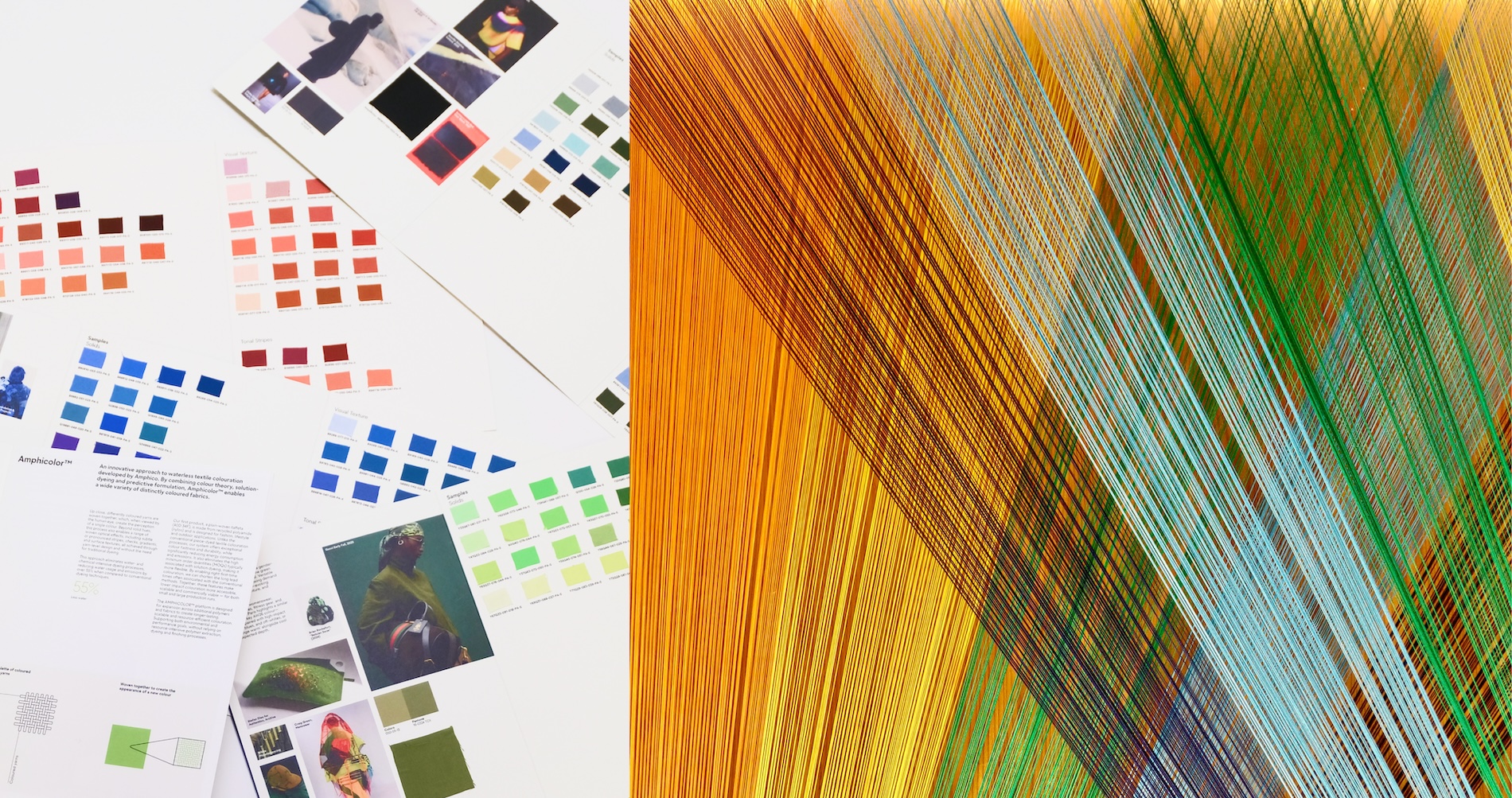
We’ve validated the process on 40D rNylon, with just 6 base yarns, we can achieve more than 5,000 colours. Compared to conventional wet dyeing, this fabric achieves a 55% reduction in water use, a 16% reduction in CO2 equivalent, and a 15% reduction in electricity consumption, based on internal analysis (a third-party LCA is underway). These are process-level results, but they present the possibility for brands to harness the water-saving benefits of solution dyeing across fibre types, yarn densities and applications.
Because colour is defined through weave rather than dye, what Amphicolor™ produces cannot simply be matched by a dye bath. The colours in our fabrics emerge from the interaction of multiple yarns across thousands of weave intersections. No single yarn is responsible for what you see. The result is tonal depth and surface variation that conventional dyeing, by its nature, cannot replicate.
Less water, less waiting, less waste
For brands, Amphicolor™ means colour validated digitally before a metre is woven, lower minimum order quantities, compressed development timelines, and measurable environmental data that satisfies growing ESG reporting requirements. The creative constraints that have defined colour development for 150 years are not inherent to the process. They are a consequence of the chemistry.
For weavers and mills, our technology offers a differentiated capability that opens new brand relationships, reduces trial waste through digital prediction, and generates a smaller, more efficient yarn inventory without limiting colour output.
Wet dyeing is a supply chain constraint dressed as a colour process. Amphicolor™ removes the constraint and opens the door to limitless possibilities in colour.
.svg)